Share
Introduction: Why Your Child's First Shoes Are Their Most Important
As a parent, you make countless decisions to ensure your child's healthy development. Among the most critical, yet often overlooked, are the shoes you put on their feet. A child's foot is not simply a smaller version of an adult's; it is a delicate, developing structure, composed mostly of soft, pliable cartilage that will not fully harden into bone until their late teens. The footwear choices made during these formative years can have a lifelong impact on their gait, posture, and overall musculoskeletal health.
This guide provides parents with an authoritative, evidence-based look at children's footwear. We will explore what pediatricians and podiatrists recommend, break down the benefits of a "barefoot is best" approach, and offer a practical checklist for choosing barefoot shoes for kids that will help, not hinder, your child's natural development.
2026 Update: The barefoot shoe movement for children continues to gain momentum in 2026. A growing body of peer-reviewed research published in late 2025 and early 2026 further supports what podiatrists have long recommended: minimalist footwear promotes healthier foot development in children. New studies from the University of Liverpool and the German Sport University Cologne have reinforced findings that children wearing barefoot-style shoes show improved balance, stronger foot musculature, and better proprioception compared to those in conventional shoes. Also, school districts in parts of Australia and New Zealand have begun officially accepting barefoot-style shoes as part of their uniform policies, reflecting a broader cultural shift. The market has also responded, with more brands offering durable, stylish options that meet both playground demands and classroom dress codes. At JOYO, we have expanded our kids barefoot shoe collection for 2026 with new styles designed for every age and activity.
"Barefoot is Best": What Pediatricians and Podiatrists Actually Recommend
When it comes to the healthy development of a child's foot, there is a remarkable consensus among medical experts: barefoot is best. This principle forms the foundation of official recommendations from leading pediatric health organizations.
The American Academy of Pediatrics (AAP) Barefoot Model
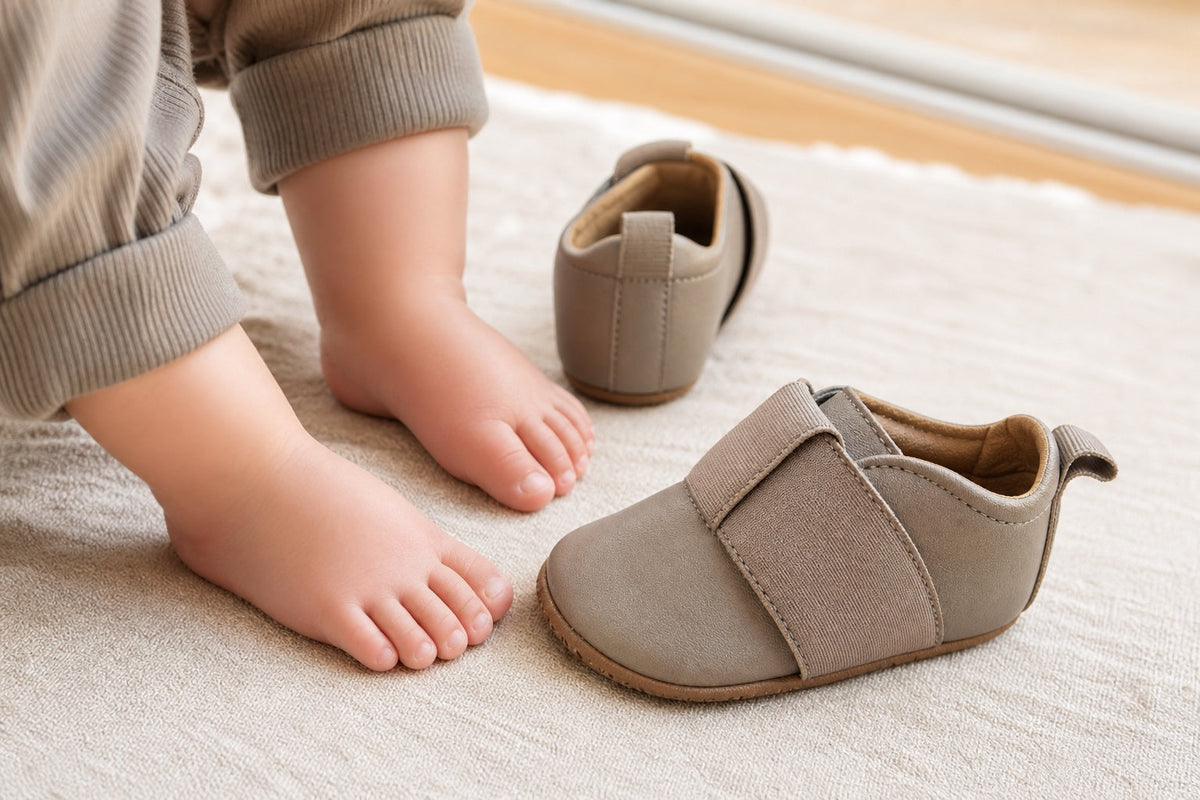
The American Academy of Pediatrics (AAP) is clear in its guidance. For infants and crawlers, shoes are unnecessary and serve only for warmth or protection. Once a child begins to walk, parents should select footwear based on the "barefoot model". The AAP advises that at home, in a safe environment, toddlers should be left barefoot as much as possible. This allows them to learn to walk by gripping the ground with their toes, a process that is critical for developing the intrinsic muscles of the foot and building a strong, natural arch. When shoes are needed for protection outdoors, they should be lightweight and flexible, allowing the foot to bend and move as if it were barefoot.
The Podiatry Consensus on Early Development
Podiatric associations, like the American Podiatric Medical Association (APMA), echo this advice. Medical experts agree that for pre-walkers, shoes serve no purpose other than protection. They emphasize that the arch of the foot is not a rigid structure that needs to be propped up by artificial supports. Rather, it is a dynamic arch formed by muscles that must be worked and exercised to develop properly, a process that is inhibited by rigid, supportive shoes. Research has shown that this approach has tangible benefits; studies indicate that children who spend more time barefoot tend to have healthier foot shapes, with wider toe splay and a lower incidence of bunion-related deformities (hallux angles) compared to children who are habitually shod.
A fascinating and telling paradox exists within footwear advice. For children, the overwhelming medical consensus advocates for a barefoot, flexible, and unsupportive model to allow for healthy, natural development. Yet, the moment a person becomes an adult, particularly an adult with foot pain, the conventional advice often flips entirely. The default prescription becomes rigid, supportive shoes and corrective orthotics designed to brace and control the foot. This raises a critical question: why are we encouraging a developmental path for children that is the complete opposite of how we treat adults? This suggests that the very foot problems many adults face, weak arches, bunions, plantar fasciitis, may be, in part, the long-term consequences of abandoning the "barefoot is best" principle in childhood. It powerfully reframes the adult barefoot shoe movement not as a radical fad, but as a return to the developmental ideal, an attempt to reclaim the natural foot function that conventional footwear may have compromised.
The Benefits and Considerations of Barefoot Shoes for Growing Feet
For parents considering barefoot-style shoes for their children, it is important to weigh the developmental benefits against the practical considerations. The following table provides a balanced, trustworthy overview to help you make an informed decision.
|
Pros (Supports Healthy Development) |
Cons (Practical Considerations) |
|
Promotes Natural Foot Shape & Toe Splay: A wide, foot-shaped toe box allows toes to spread naturally, preventing the cramping that can lead to future deformities. Shoes like the PureSteps are specifically designed with an extra-wide toe box for growing feet. |
Potentially Lower Durability: The lightweight, flexible materials may wear out faster than heavy-duty conventional shoes, especially with very active children who are rough on their footwear. |
|
Strengthens Foot & Leg Muscles: By allowing full, unrestricted movement, barefoot shoes encourage the development of the small muscles in the feet and lower legs, building a stronger foundation. |
Higher Initial Cost: Many high-quality barefoot brands can be more expensive than mass-market children's shoes, although budget-friendly options like the Breezy are becoming more available. |
|
Enhances Balance & Proprioception: Thin, flexible soles provide rich sensory feedback from the ground, which is important for developing good balance, coordination, and body awareness. |
Fewer Weatherproof Options: While improving, the selection of truly waterproof or heavily insulated barefoot winter boots can be more limited than in the conventional market. |
|
Encourages a Natural Gait: Without an artificial heel or rigid sole, children are free to develop a natural, efficient walking and running pattern from their very first steps. |
Can Be Hard to Dry: The soft, often fabric-based construction of some models can become saturated if submerged in water and may take longer to dry out completely. |
How to Choose the Right Barefoot Shoe for Your Child: A 5-Point Checklist
When shopping for your child's shoes, use this simple checklist to ensure you are selecting a pair that will support their healthy development. You can see all of these features in action across our JOYO Kids Collection.
-
Is it Foot-Shaped? (Wide Toe Box): Look at the shoe from above. Does it match the shape of your child's foot, or is it tapered and pointy? There should be plenty of room for their toes to wiggle and spread out comfortably. The LittleSteps and PureSteps are excellent examples of truly foot-shaped kids' shoes.
-
Is it Totally Flat? (Zero-Drop): Check the sole profile from the side. There should be no elevation or lift under the heel. The shoe should be completely flat from heel to toe.
-
Is it Flexible? (The Roll-Up Test): Pick up the shoe and try to bend and twist it. A good barefoot shoe should be pliable in all directions. You should be able to easily roll it into a ball with your hands.
-
Is it Secure? The shoe should hold securely to your child's foot to prevent them from slipping around inside or needing to grip with their toes to keep it on. Look for adjustable fastenings like laces, velcro straps, or buckles.
-
Is the Sole Thin? The sole should be thin enough to allow for good ground feel, but still thick enough to provide adequate protection from sharp objects like rocks or glass.
Top-Rated Kids' Barefoot Brands for 2025-2026
The children's barefoot shoe market is filled with excellent brands that specialize in healthy foot development. Here are a few top-rated options known for their quality and design:
-
JOYO Kids: Designed from the ground up with children's developing feet in mind, the JOYO Kids collection offers a full range of barefoot shoes for every age and activity, from the soft, flexible LittleSteps for toddlers to the durable FreeTrek cross-trainers for active older kids. Every pair features a wide toe box, zero-drop sole, and ultra-flexible construction.
-
Vivobarefoot: A leader in the field, offering durable and practical options for active kids, including waterproof models, sports shoes, and even school uniform-appropriate styles.
-
Wildling Shoes: Known for providing one of the most genuine "barefoot" feelings. Their shoes are incredibly lightweight, soft, and flexible, making them a favorite for comfort and sensory feedback.
-
Be Lenka: This brand is celebrated for its extra-wide toe box, making it an excellent choice for children with broader feet. They also offer a wide array of fun, colorful designs.
-
Splay: A fantastic budget-friendly brand, Splay offers a classic canvas sneaker style at a more accessible price point, making barefoot principles available to more families.
Red Flags: When to Consult a Podiatrist
While barefoot shoes are the ideal choice for promoting healthy foot development, they are not a medical treatment for pre-existing conditions. It is important for parents to be vigilant and seek professional medical advice if they notice any red flags. You should consult with a pediatrician or a pediatric podiatrist if your child experiences :
- Persistent Pain: If your child frequently complains of pain in their feet, ankles, or legs.
- Obvious Deformities: Any significant structural abnormalities in the feet or toes.
- Abnormal Gait: If you notice a significant and persistent gait abnormality, such as severe in-toeing (pigeon-toeing) or out-toeing, that does not seem to be resolving naturally with age.
- Frequent Tripping or Clumsiness: While some clumsiness is normal, if it is excessive and seems related to how they are walking, it warrants a check-up.
Best Barefoot Shoes for Kids by Age (2025-2026 Guide)
Choosing the right barefoot shoe depends largely on your child's age and developmental stage. Here is a breakdown of what to look for at each stage, along with our top picks from the JOYO Kids collection.
Toddlers (Ages 1-3): Soft Soles & Easy On/Off
At this age, your child is just learning to walk and their feet are at their most pliable. The priority is maximum flexibility and ground feel. Look for shoes with ultra-soft soles, a wide toe box for natural toe splay, and easy-on/easy-off closures (velcro or slip-on designs) that make diaper changes and shoe battles less stressful for everyone.
What to prioritize: Super-thin soles (3-5mm), soft upper materials, secure but simple closures, lightweight construction under 100g.
JOYO picks for toddlers:
- LittleSteps - Wide toe barefoot shoes designed specifically for first walkers, with a soft, flexible sole that lets tiny feet feel the ground.
- MiniBare - Breathable mesh barefoot shoes that are incredibly light and easy for toddlers to move in.
Little Kids (Ages 4-7): Durable & Playground-Proof
Once your child is running, jumping, and climbing with confidence, durability becomes more important. Kids in this age range are hard on their shoes, so you need pairs that can survive the playground, the sandbox, and everything in between, while still maintaining barefoot principles.
What to prioritize: Reinforced toe caps, non-slip outsoles, breathable but sturdy uppers, secure closures that kids can manage themselves.
JOYO picks for little kids:
- KidStride - Non-slip unisex barefoot shoes built to handle active play, with a durable outsole and a roomy toe box.
- FlexMove - Breathable barefoot shoes for boys and girls, designed for all-day comfort and freedom of movement.
- BareFit - Mesh barefoot shoes that are lightweight enough for school but tough enough for recess.
Big Kids (Ages 8-12): Style Matters & Active Support
By this age, kids start to care about how their shoes look. The good news is that barefoot shoes have come a long way in design. You no longer have to sacrifice style for foot health. Look for shoes that combine the essential barefoot features with designs your child will actually want to wear, trendy colors, sporty profiles, and options that fit in at school and during sports.
What to prioritize: Styles your child approves of, options for different activities (casual, sports, school), growing room without being too loose.
JOYO picks for big kids:
- FreeTrek - Breathable barefoot cross-trainers built for sports, gym class, and outdoor adventures.
- FlexFit - Super comfy barefoot shoes with a sleek profile that looks great at school or hanging out with friends.
- BareFlow - Fashionable barefoot sneakers with a modern design that older kids love.
Teens (Ages 13+): Adult Styles & Transitional Options
Teenagers can begin transitioning to adult barefoot shoe models. If your teen has been wearing conventional shoes their whole life, a gradual transition is important, start with shoes that have a slightly thicker sole and work toward thinner, more minimal options over several weeks. If they have been wearing barefoot shoes since childhood, they can move directly into adult styles.
What to prioritize: Adult sizing, style versatility (school, casual, sport), gradual transition if new to barefoot, proper fit as feet reach final size.
JOYO picks for teens:
- Flexiroam - Wide toe minimalist sneakers that bridge the gap between kids' and adult barefoot shoes.
- PureSteps - Wide toe barefoot shoes available in sizes that work for teens transitioning to adult barefoot footwear.
Browse the Full JOYO Kids Barefoot Shoe Collection
Conclusion: Giving Your Child the Gift of Strong, Healthy Feet for Life
The greatest gift you can give your child's feet is the freedom to develop as nature intended. By embracing the "barefoot is best" philosophy, whether through actual barefoot time or by choosing footwear that mimics it, you are helping them build a strong, stable, and sensory-rich foundation. This is an investment in their long-term health that will support them through a lifetime of confident, comfortable, and joyful movement.
At JOYO, we design our kids' barefoot shoes with these same principles at their core. Every pair in our collection features a wide toe box, zero-drop sole, and ultra-flexible construction that lets young feet grow strong and healthy. Explore the JOYO Kids collection and give your child the foundation they deserve.
Frequently Asked Questions About Barefoot Shoes for Kids
At what age can kids start wearing barefoot shoes?
Children can start wearing barefoot-style shoes as soon as they begin walking, typically around 9 to 15 months of age. Before that, bare feet or soft booties for warmth are all that is needed. Once your child takes their first independent steps, a pair of soft-soled barefoot shoes like the LittleSteps provides the protection they need outdoors while allowing their feet to develop naturally. The key is to choose shoes that are as close to barefoot as possible, thin, flexible, flat, and wide in the toe area.
Are barefoot shoes good for toddlers learning to walk?
Yes, barefoot shoes are considered the best type of footwear for toddlers who are learning to walk. Both the American Academy of Pediatrics and podiatric medical associations recommend that new walkers spend as much time barefoot as safely possible, and that when shoes are needed, they should follow barefoot principles: flat, flexible, and foot-shaped. This allows toddlers to grip the ground with their toes, develop balance, and build the intrinsic muscles of their feet, all of which are critical for healthy walking development. Rigid, supportive shoes can actually interfere with this natural learning process.
Do barefoot shoes help with flat feet in children?
For most children, flat feet are completely normal and part of healthy development. The arch typically develops gradually between ages 3 and 6 as the muscles of the foot strengthen through use. Barefoot shoes support this process by allowing the foot to move freely and exercise naturally, rather than relying on artificial arch support that can prevent muscle development. Research suggests that children who go barefoot or wear minimalist shoes tend to develop stronger arches over time. However, if your child's flat feet persist beyond age 6, are painful, or are accompanied by other symptoms, you should consult a pediatric podiatrist to rule out any underlying conditions.
How should barefoot shoes fit on kids?
Barefoot shoes should fit differently from conventional shoes. Here is what to check: there should be approximately 10-12mm (about a thumb's width) of space between your child's longest toe and the end of the shoe to allow for growth and natural foot movement. The toe box should be wide enough that toes can spread freely without being cramped. The shoe should feel snug around the midfoot and heel without being tight, and the child should not be sliding around inside the shoe. Unlike conventional shoes, there should be no "break-in" period, barefoot shoes should feel comfortable from the first wear. Measure your child's feet every 2-4 months, as children's feet can grow up to two full sizes per year.
Are barefoot shoes safe for kids to play sports in?
For most recreational sports and physical activities, barefoot shoes are not only safe but beneficial. They allow children to develop better balance, proprioception, and foot strength during physical activity. Shoes like the FreeTrek are specifically designed as barefoot cross-trainers suitable for gym class, running, and general sports play. That said, some organized sports leagues may require specific types of footwear (such as cleats for soccer or specific court shoes for basketball). In those cases, look for the most minimalist option that meets the sport's requirements. For general playground activities, PE class, running, hiking, and recreational sports, barefoot shoes are an excellent choice that supports natural movement patterns.
What is the difference between barefoot shoes and regular kids shoes?
The differences between barefoot shoes and conventional kids' shoes are significant and affect how a child's foot develops:
- Sole: Barefoot shoes have thin, flexible soles (typically 3-8mm) that allow ground feel. Regular shoes have thick, rigid soles that block sensory feedback.
- Heel: Barefoot shoes are completely flat (zero-drop), meaning the heel and toe are at the same height. Regular shoes typically have an elevated heel that alters natural posture and gait.
- Toe box: Barefoot shoes have a wide, foot-shaped toe box that allows toes to spread naturally. Regular shoes often taper toward the toes, cramping them together.
- Flexibility: You can roll a barefoot shoe into a ball. Regular shoes are rigid and resist bending.
- Arch support: Barefoot shoes have no arch support, allowing the foot's muscles to develop naturally. Regular shoes often include built-in arch support that can weaken foot muscles over time.
- Weight: Barefoot shoes are significantly lighter, reducing energy expenditure and allowing more natural movement.
How long does it take for kids to adjust to barefoot shoes?
The adjustment period depends on your child's age and what they have been wearing previously. Children who have primarily gone barefoot or worn soft-soled shoes will adapt almost immediately. For children transitioning from conventional shoes with thick soles and arch support, a gradual transition of 2-4 weeks is recommended. Start by having them wear the barefoot shoes for a few hours per day, gradually increasing the duration. You may notice some initial complaints about feeling rocks or uneven surfaces through the thin sole, this is normal and actually a sign that the shoes are working as intended, allowing sensory feedback that helps build stronger feet. Most children adapt more quickly than adults because their feet are still flexible and have not been weakened by years of conventional footwear.
Are barefoot shoes good for kids with wide feet?
Barefoot shoes are actually the best option for children with wide feet. Unlike conventional shoes that come in standard widths and often compress wider feet, barefoot shoes are designed with foot-shaped toe boxes that accommodate the natural width of a child's foot. In fact, a wide foot is often a sign of healthy foot development, it means the toes have had the freedom to spread naturally. Models like the PureSteps and LittleSteps from our JOYO Kids collection are specifically designed with extra-wide toe boxes that give wide feet the room they need without sacrificing a secure fit around the heel and midfoot.
What should I look for when buying barefoot shoes for my child?
When shopping for kids' barefoot shoes, use this checklist of the five essential features:
- Wide, foot-shaped toe box - The shoe should mirror the natural shape of your child's foot, widest at the toes.
- Zero-drop sole - Completely flat from heel to toe with no elevated heel.
- Thin, flexible sole - You should be able to bend and twist the shoe easily. The sole should be thin enough for ground feel (3-8mm).
- Lightweight construction - The shoe should be light enough that it does not weigh down your child's natural movement.
- Secure fit - Adjustable closures (velcro, laces, or elastic) that keep the shoe snug without restricting the foot.
Beyond these basics, consider the shoe's durability (especially for active kids), breathability, ease of cleaning, and whether the design appeals to your child. Browse our JOYO Kids collection to see shoes that check every box on this list.
Can kids wear barefoot shoes to school?
Yes, in most cases children can wear barefoot shoes to school. Many barefoot shoe brands, including JOYO, now offer designs that look like conventional sneakers and meet typical school dress codes. Shoes like the FlexFit and BareFit have a modern sneaker appearance that fits right in at school while maintaining all the barefoot benefits underneath. For schools with stricter uniform requirements (such as black shoes only), check with your school's policy first. The growing acceptance of barefoot shoes in educational settings, particularly in 2025 and 2026, means that more schools are recognizing these shoes as appropriate footwear. Some parents find it helpful to share information about the health benefits with their child's school if there are any questions about the shoes' suitability.