

Best Barefoot Safety Boots: 5 Real Steel-Toe Picks for Wide Feet (2026)
Barefoot Safety Boots: Why They Barely Exist, and the 5 That Get Closest
You want your toes to spread out and your foot to move the way it was built to move. Your job says you need a certified toe over those toes. Almost nobody makes a boot that does both. Not because brands are lazy, but because the two goals physically fight each other inside the boot.
This guide explains why that fight happens, what "certified" actually means on a spec sheet, who genuinely needs a protective toe versus who just wants a tough wide boot, and the five boots on the market right now that come closest to giving you both. They are ranked by how close each one gets to real barefoot feel without giving up the protection. Carets Determination is the top pick, and the gap between it and everything else is wider than you would expect.
The problem nobody warns you about
If you have already worn barefoot or minimalist shoes, you know the feeling you are chasing. A wide front so your toes splay instead of getting squeezed into a point. A flat sole, heel and toe at the same height, so your posture sits naturally over your foot. A thin, bendy sole so your foot does the stabilizing work it is built to do, and so you actually feel the ground. That ground feel is not just a nice sensation. It is real proprioception and nerve feedback that helps your foot read and react to the surface under it.
Then you start a job where the dress code includes a protective toe. Concrete crews, warehouses, electrical work, plumbing, landscaping, factory floors. The moment you shop for a steel or composite toe boot, every option feels like a brick. Pointed front, jacked-up heel, a sole so stiff you might as well be standing on a board. You are not imagining it. The two worlds were built on opposite assumptions, and that is the whole story.
The engineering reason this is so hard
Here is the part most roundups skip, and it is the most useful thing on this page.
A certified safety toe is not a soft cushion. It is a rigid shell, steel or composite, with a fixed internal shape that does not flex. To pass a safety test, that shell has to hold its geometry under a heavy impact and under steady crushing weight. So it is molded once, to one shape, and it stays that shape forever. That is the entire point of it.
Now look at what makes a boot feel barefoot. It is the last. The last is the foot-shaped form a boot is built around, and a barefoot boot uses an anatomical last: widest at the toes, following the real fan shape of a human foot. A conventional boot uses a tapered last that narrows to a point well before your actual toes end, because that is the shape the footwear industry standardized on a century ago for looks, not for feet.
A certified toe cap is shaped for that conventional tapered last. It is a pointed dome. When a brand tries to drop that same rigid pointed cap onto a wide anatomical last, the cap fights back. It is a fixed shape pushing inward exactly where a barefoot boot is supposed to open outward. You cannot just widen the cap either, because a wider cap is a bigger, heavier, harder-to-certify piece of steel sitting on the front of your foot.
So brands get forced into a choice. Nail the wide toe box and skip certification, which is most barefoot brands. Or get certified on a conventional last with a raised heel, which is every mainstream work boot. Building a rigid certified cap that still respects a wide foot is genuinely hard tooling and genuinely expensive, which is why the boots that pull it off cost more and there are only a handful of them. When you understand that, the prices on this page stop looking crazy and start looking like what they are: the cost of solving a real problem. If the $265-plus numbers still sting, it is worth running the real math of barefoot versus traditional footwear before you decide, because a resoleable welted boot you keep for years often costs less per mile than the cheap pair you replace every season.
How to actually read a safety spec sheet
Before you spend a cent, you need to read the rating yourself, because "safety toe" in a product title means nothing on its own. Here is what the numbers mean.
ASTM F2413-18 vs EN ISO 20345
These are the two standards you will see. ASTM F2413-18 is the United States standard, set by ASTM International, and it is the one that matters if you work in the US. EN ISO 20345 is the European equivalent, common on boots made in Spain, Portugal, and the UK. A boot can carry both. If you are buying for a US worksite, confirm the ASTM line is present. A European rating alone may not satisfy your site's requirements, so check what your employer or trade actually demands.
Steel toe vs composite toe
Both can meet the exact same impact and compression rating, so neither is automatically safer. Steel is thinner for the same protection, cheaper, and proven, but it conducts heat and cold straight to your toes and it sets off metal detectors. Composite (carbon fiber, fiberglass, or hard plastic) is lighter and does not conduct, which matters for cold climates and electrical work, but the toe box runs slightly bulkier because it takes more material to hit the same strength. Pick on weight, temperature, and whether you work near electricity, not on a vague sense that metal is tougher.
Impact and compression ratings
Under F2413-18 the toe rating is written as I/75 and C/75. I/75 means the toe survives a 75 foot-pound impact, roughly a heavy object dropped from height. C/75 means it withstands 2,500 pounds of slow compression, like a wheel or pallet rolling over your foot. Both are baked into a compliant safety toe. If a listing shows the ASTM F2413-18 I/75 C/75 line, the toe is doing its real job.
Puncture plate (PR)
This is a separate spec, and it trips people up. A boot can have a certified toe and zero protection against a nail going up through the sole. The puncture-resistant midsole is marked PR. If you walk job sites with nails, screws, or sharp debris underfoot, you need PR called out explicitly. Never assume a safety toe includes it.
Slip resistance
Slip ratings are not part of the toe certification at all. They are tested separately, usually as a slip-resistant or oil-resistant outsole. If you work on wet, oily, or polished floors, this is as important to your safety as the toe, and it is the spec that actually stops you from going down on a Tuesday morning.
Read all of these on the live listing, not in a roundup like this one. Manufacturers update specs between production runs, and the rating is the one thing you cannot judge by looking at the boot.
Do you even need a certified toe?
Honest question, and the honest answer saves some of you a lot of money and a worse-fitting boot.
You need a certified toe if your worksite requires it as a condition of being there. Most commercial construction, industrial, warehouse, and many trade environments mandate ASTM-rated footwear, often because OSHA foot protection rules push the requirement down onto the employer, and they can send you home without it. If a regulation or an employer says certified, no wide rugged boot substitutes for the rating, no matter how tough it looks.
You probably do not need a certified toe if you want a heavy-duty wide boot for hiking, ranch work, your own property, hobby woodworking, or general outdoor life where nothing is dropping 2,500 pounds on your foot. In that case a rugged, wide, uncertified barefoot boot is more comfortable, more flexible, and cheaper, and chasing a safety rating you do not need just buys you a stiffer boot. Be honest with yourself about which group you are in before you shop. It is the single biggest reason people return work boots.
How to choose for wide feet
Once you know you need certification, four things decide whether the boot is right for your foot.
- Toe box width. This is the whole game for barefoot wearers. You want the front of the boot to follow your toe splay, not pinch it. With a certified cap involved, measure your real foot width and check the brand's width options, because a certified toe runs narrower than an uncertified one by nature.
- Heel-to-toe drop. Zero-drop means heel and forefoot sit at the same height. Most certified boots have a raised heel. True zero-drop with a certified toe is the rarest combination here, so decide if drop is the thing you will not compromise on.
- Sole flexibility. Barefoot feel comes from a thin, bendable sole. Safety boots tend toward thick and stiff. You will likely give up some ground feel for protection, so look for the most flexible sole that still carries the rating you need. If you are easing back into wider footwear while recovering from foot surgery or injury, go slower on the transition and lean toward more flex, not less.
- Break-in and sizing. Leather safety boots, especially Goodyear-welted ones, need a real break-in period before they feel like yours. Wide feet should size for the widest part of the foot, not the length, and many of these brands run width-specific rather than just up a size. When in doubt, size for the toe box.
The 5 boots that get closest, ranked
1. Carets Determination, the top pick
This is where to start if you flat-out refuse to give up barefoot feel. The Determination is built zero-drop on a genuinely foot-shaped last with the widest toe box we tested in a certified boot, and it still carries a real steel toe rated to ASTM F2413-18. It is Spain-made and Goodyear welted, so when the sole wears out you resole it instead of landfilling the whole boot. The catch is the price, around $275, and the break-in that comes with real welted leather. It is the rare boot that genuinely tries to win on both fronts instead of picking one, and it mostly succeeds. Confirm the current ASTM line on the listing before you buy, since the rating is the part that matters most.
Check the current price on the Carets Determination →
2. Gaucho Ninja
Handmade in Portugal with one of the widest toe boxes you will find on any boot, certified or not, plus a resoleable Goodyear welt. It carries an EN ISO 20345 rating with ASTM F2413, and the model we point to uses a composite toe, which keeps the front lighter than steel. At around $265 it sits right alongside the Carets on price. If raw toe splay is your single highest priority, this is the field to look at. The one thing to watch: the protective spec varies by model across the line, so confirm the exact pair you are buying carries the certified toe before you treat it as a safety boot.
Check the current price on the Gaucho Ninja →
3. KEEN Utility Milwaukee
Not zero-drop, and KEEN does not pretend otherwise. What it nails is room. It is built on KEEN's foot-shaped last with a wider forefoot and their asymmetrical toe cap, offered in steel or carbon-fiber, shaped to follow the foot instead of crushing the big toe into a point. It is ASTM rated, sold almost everywhere, comfortable on day one, and needs little to no break-in. At roughly $150 to $180 it is the easy, mainstream pick if you have wide feet or bunions and you care more about all-day comfort than chasing true minimalism. Think of it as the gateway: roomier than the average work boot, without asking you to spend premium money.
Check the current price on the KEEN Utility Milwaukee →
4. FitVille work boot
The value play. FitVille builds for wide and extra-wide feet specifically, with a composite safety toe the brand lists as ASTM rated, a roomy forefoot, and serious all-day cushioning. Composite runs lighter than steel and is non-conductive, which earns it a spot on long shifts standing on hard floors. If you do all-day standing on concrete or pull 12-hour shifts on your feet, that cushioning is the trade you are making on purpose. It is not minimalist and it is not zero-drop, the cushioning sees to that, but at roughly $80 to $110 it is the most boot for the money on this list. Confirm the exact toe and any puncture rating on the listing, since composite specs differ by model.
Check the current price on the FitVille work boot →
5. Ariat
The least barefoot boot here and the one most likely to outlive everything else you own. Ariat makes ASTM-rated work boots with wide sizing options, tough full-grain leather, slip-resistant outsoles, and a steel toe the brand lists to ASTM F2413. It is conventional through and through, raised heel, stiffer build, so cross it off if zero-drop is non-negotiable for you. But if you work wet, cold, and hard and you mostly want durability with enough width to not murder your toes, around $130 to $160 buys a boot that takes a beating. If your worksite means snow and ice underfoot, remember a steel toe conducts the cold straight to your toes, which is one more reason to weigh composite if your site allows it. It earns its spot on toughness, not on barefoot feel.
Check the current price on Ariat work boots →
At a glance
| Boot | Toe | Drop | Price | Best for |
|---|---|---|---|---|
| Carets Determination | Steel, ASTM F2413-18 | Zero-drop | ~$275 | Barefoot feel plus certification |
| Gaucho Ninja | Composite, EN ISO 20345 + ASTM F2413 | Low / flat | ~$265 | Widest toe box |
| KEEN Utility Milwaukee | Steel or carbon-fiber, ASTM | Standard heel | ~$150 to $180 | Wide feet, day-one comfort |
| FitVille work boot | Composite, ASTM | Low | ~$80 to $110 | Budget, long shifts |
| Ariat | Steel, ASTM F2413 | Standard heel | ~$130 to $160 | Wet, heavy-duty sites |
A straight note about our own boot
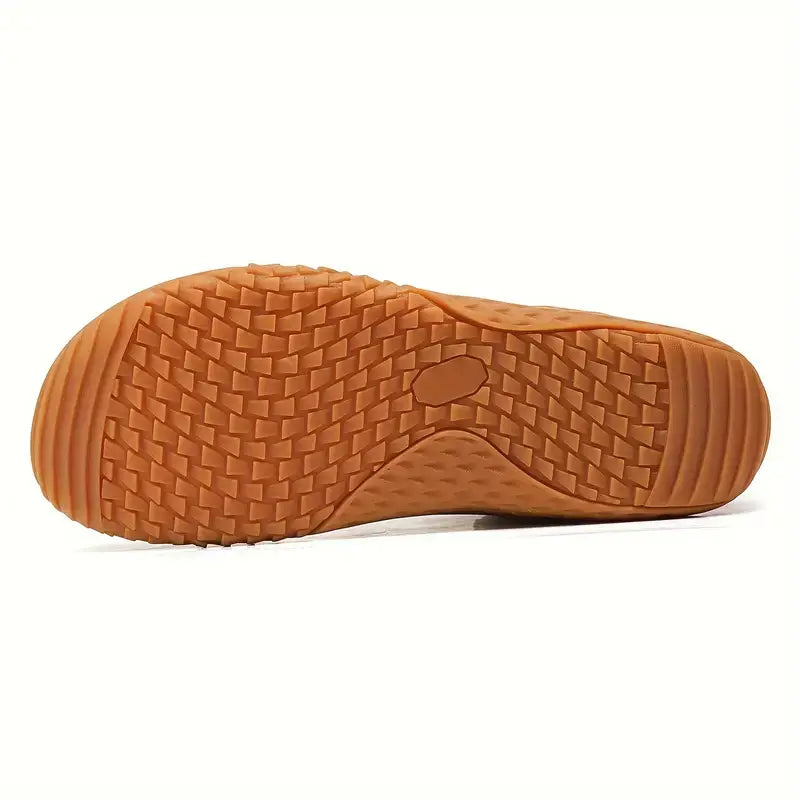
The Joyo Titan is a casual, everyday barefoot boot. It is not a safety boot. No steel toe, no puncture-resistant plate, no ASTM rating, and it is not built or tested for protection. Do not wear it anywhere that requires certified foot protection. It is also not available to buy right now. We leave this note here on purpose: if you came looking for a real work boot, we would rather send you to the five picks above than sell you the wrong thing.
How to choose for your situation
Strip it down to one decision: which thing will you not compromise on?
If it is barefoot feel above all, and you can spend for it, the Carets Determination is the only boot here that is truly zero-drop and wide-toed while still carrying a certified steel toe. If toe splay is your obsession and a low flat sole is close enough, the Gaucho Ninja gives you the widest front of the group. If you want roomy and certified without premium money, KEEN is the comfortable, everywhere-available pick. If budget is the constraint and you stand all day, FitVille gives you the most boot per dollar. And if you work in brutal conditions and durability beats minimalism, Ariat is built to survive it.
Whatever you choose, confirm the exact toe type and ASTM rating on the current product page before you check out. The rating is the one thing you cannot eyeball, and it is the only thing standing between your foot and a bad day.
Frequently asked questions
Are there real barefoot safety boots?
What is the most barefoot-friendly steel-toe work boot?
Do zero-drop work boots meet ASTM safety standards?
What is the difference between a composite toe and a steel toe?
What does ASTM F2413-18 actually mean?
Are Joyo Titan boots safety boots?
Learn more